Monday, April 13, 2020

Homebase and consumer spending

Two things today:

1. Homebase


Discovered Homebase data. Homebase provides a scheduling and time tracking tool, and they've made a dataset publicly available that comprises 60,000 US businesses and 1 million hourly employees. It's the most impressive high frequency economic dataset I've seen, and the numbers are jarring. Relative to median hours for a given weekday during Jan. 4 - Jan. 31, 2020, 66 percent fewer local businesses are open and 75 percent fewer hourly employees are working as of April 12, 2020. The beauty and personal care industry has been the hardest hit, with only 4 percent of firms still open on April 12, followed by leisure and entertainment (84 percent). Groups such as the Rustandy Center at Chicago Booth have conducted some useful analyses with this data.

The chart below, provided by Homebase, shows a time series of hours worked by hourly employees through April 11:


Sunday, April 12, 2020

Central Bank Liquidity Swaps, or Europe to Japan

I've been re-reading Adam Tooze's Crashed and so much is relevant. Today, central bank liquidity swaps.

During the financial crisis, the dollar funding needs of foreign banks (in particular European banks) would have quickly overwhelmed the foreign exchange reserves of their home-country central banks. To deny these commercial banks liquidity assistance could have been disastrous, but lending to the most fragile foreign banks without adequate collateral would have exposed the Federal Reserve to significant risk. As a solution, the Fed provided liquidity assistance to international banks through swap lines set up with other central banks. They were not a new invention in 2007, but the Fed used them on an unprecedented scale.

Tooze writes
“from 2007 the Fed repurposed an instrument that was first developed in the age of Bretton Woods. To manage the fixed currency system in the 1960s the central banks had developed a system of so-called currency swap lines that allowed the Fed to lend dollars to the Bank of England against a reverse deposit of sterling in the accounts of the Fed. Having gone out of use in the 1970s, the swap lines had been briefly revived in 2001 to deal with the aftermath of 9/11. In 2007 faced with the implosion of the transatlantic banking system, they were repurposed and expanded on a gigantic scale to meet the funding needs not of sovereign states but of Europe's megabanks." (p. 209-210)
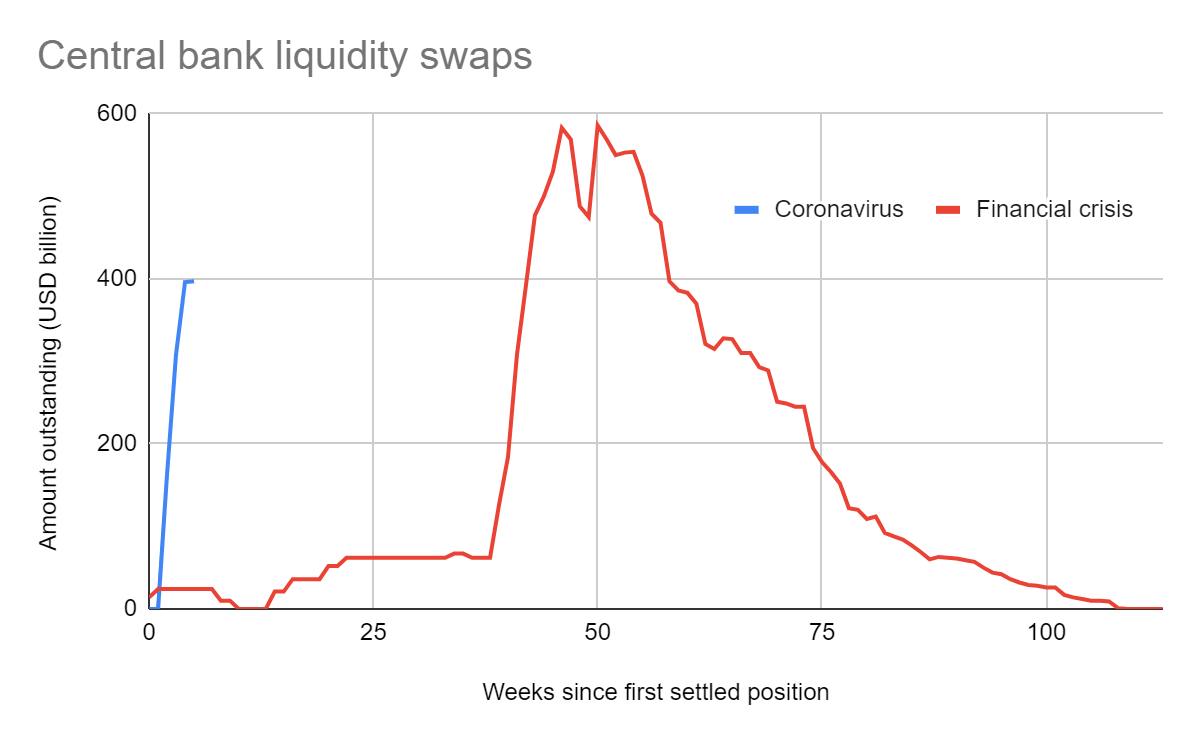
The total amount outstanding on these dollar swap lines peaked at over $580 billion in December 2008, with over $310 billion outstanding with the European Central Bank. The swap lines prevented a euro-dollar or sterling-dollar crisis. “What the Fed had done for money markets, the central banks now did for the global provision of dollar bank funding. They absorbed the currency mismatch of the European bank balance sheets directly onto their own accounts.”

At the start of the financial strains due to the coronavirus pandemic in February 2020, the Federal Reserve had standing swap arrangements with the central banks of Canada, England, Europe, Japan, and Switzerland. On March 19 it added temporary arrangements with the central banks of Australia, Brazil, Denmark, Korea, Mexico, New Zealand, Norway, Singapore, and Sweden.

As of April 9, 2020, over $396 billion was outstanding. Three charts, using data from the New York Fed, and thoughts below.

Figure 1: This crisis struck funding markets much more quickly than the 2007-08 crisis. 


Thursday, April 9, 2020

Buybacks: OK in Theory; Bad in Practice.

In theory, if a company is unable to invest a portion of its retained earnings at the same level of (risk-adjusted) returns available elsewhere, it is better for its shareholders and the economy as a whole for that company to return that money to the shareholders so that they can invest in higher-yielding projects, leading to a more efficient allocation of capital in the economy. The reality, however, is different. When a majority of companies is repurchasing shares at the expense of investment in research and development, and in some cases borrowing money to repurchase shares, it suggests that something is amiss.

S&P 500 firms have repurchased over $5.4 trillion worth of shares since 2009. Well-positioned staff have been profiting at general shareholders' expense while introducing fragility into the system. Despite the theoretical benefits of buybacks in certain circumstances, the risks created by them have become obvious during the coronavirus pandemic. Some of the companies requesting federal loans and grants were the ones aggressively repurchasing shares during the past few years. There is anger because nearly 17 million American have filed for unemployment in the past three weeks and, as William Lazonick mentioned, "If companies are paying dividends and doing buybacks, they do not have to lay off workers."

In Why Stock Buybacks Are Dangerous for the Economy, Lazonick, Mustafa Erdem Sakinç and Matt Hopkins explain that "When companies do these buybacks, they deprive themselves of the liquidity that might help them cope when sales and profits decline in an economic downturn." During the drafting of the first coronavirus response bill, The New York Times summarized the awkwardness of companies like the major airlines asking the federal government for bailout money after spending $19 billion repurchasing shares over the last three years. President Trump said, "I don't want to give a bailout to a company and then have somebody go out and use that money to buy back stock in the company and raise the price and then get a bonus. OK?" In response to buybacks' financial and political downsides, the Coronavirus Aid, Relief, and Economic Security (CARES) Act signed March 27 precludes certain businesses that receive relief loans through the Act from repurchasing equity securities for up to "12 months after the date on which the direct loan is no longer outstanding."

The negative aspects of buybacks should not come as a surprise. In 2014's Profits Without Prosperity, Lazonick describes how "the corporate resource allocation process is America's source of economic security or insecurity". The shift from the retain-and-reinvest approach, in place between WWII and the 1970's, to the current downsize-and-distribute regime reflects the shift from an economic model in which corporations create value to one in which they extract it. Not surprisingly, the value creation setup is more stable and sustainable. The value extraction setup contributes to the employment instability and income inequality (and slower productivity growth) evident today.

In January 2018, Dan McCrum examined whether US companies' huge repurchases made sense, considering that investment in development was stuck at pre-crisis levels and stock prices were high (buybacks make more sense when a corporation considers its shares to be undervalued by the market). Given repatriation rule changes in 2017's TCJA, it was clear that buybacks were going to remain near record levels. He examines five charges :

Charge Verdict
1. Staff benefit more than shareholders Guilty
2. Opportunity for manipulation Not Guilty
3. Executives can be a bad judge of value Guilty
4. Buybacks reduce real investment The Jury is Out
5. Encouraging fragility Guilty as Hell

Following up on the charge that buybacks encourage fragility, Lazonick, Sakinç and Hopkins (2020) highlight the issue with the corporate buyback boom: up to 30 percent of buybacks in 2016 and 2017 were financed by corporate bonds. These "debt-funded" payouts, encouraged by low interest rates, are a form of financial risk-taking that "can considerably weaken a firm's credit quality." (IMF GFSR)

The Atlantic summarizes the investor-level and economy-level impacts: "The proliferation of stock buybacks is more than just another way of feathering executives’ nests. By systematically draining capital from America’s public companies, the habit threatens the competitive prospects of American industry—and corrupts the underpinnings of corporate capitalism itself."

-------------------------------------------------------------------------------------------

Other things to look into:

There are of course factors within the legal framework that help explain why buybacks have increased. The main example is the SEC's Rule 10b-18, which creates a "safe harbor" in which companies are free from risk of liability for stock price manipulation as long as they follow conditions laid out in the Rule.

But I wonder to what extent the economic situation has led to more buybacks. Decreased productivity and population growth, among other factors pulling the "natural rate of interest" down, might indicate that the marginal product of capital is lower today than it has been at any other point since the end of the 1930's, when Alvin Hansen was worried about secular stagnation. Companies might simply not have investment opportunities that stand up to the ROI expectations ingrained in their executives' minds since their 1990's MBA programs where their professors were teaching corporate finance classes and the 10-year Treasury yield of around 7 percent was 10 times higher than it is today. Part of this is a question of capital accumulation and how our society structures itself for the Japanese experience of low growth -- which does not have to be bad!

Lastly, to the extent that federal spending on research crowds in private spending on research and development, how much of the growth in buybacks is a result of the public sector stepping away from its active role in promoting growth? The work of economists such as Enrico Moretti, Mariana Mazzucato (The Entrepreneurial State), and Bill Janeway (Doing Capitalism in the Innovation Economy) shows how government spending on research (and government's ability to create a market for technologies before they are ready for commercial success) "crowds in" private sector spending on research and development.

Tuesday, April 7, 2020

Bank capital and German Google searches

Two thoughts today.

1. Are the banks really safer


People are saying the post-financial crisis regulations have done their job and the banking sector is much safer now. In some ways yes, banks now have better liquidity positions (and the Fed acts more quickly when companies need cash), stress tests, resolution plans, more active risk management departments, and a slew of other new regulations. But the most important metric, bank equity levels, are not so much higher.

The Federal Reserve Bank of Minneapolis' Plan to End Too Big to Fail calculated that to keep the probability of a bank crisis in the next century below 10 percent, banks would need capital amounting to 38 percent of assets. Here is how bank capital has progressed against that since 2007:


Sunday, April 5, 2020

Coronavirus and The Affluent Society

The coronavirus pandemic has highlighted the importance of healthcare, food, shelter, and jobs to a greater extent than any other crisis since World War II. It is serving as a stark reminder that the health of loved ones and access to the basics are the most important things.

Fortunately, lawmakers recognize the existential risks of an economic breakdown and have responded with large stimulus measures. And they realize that they can continue to do so, with multiple rounds of stimulus if necessary. As President Trump, America’s first president to implicitly embrace modern monetary theory, replied when asked how we’ll pay for it: “It’s our money. We are the ones. It’s our currency.” As long as we remain within our nation’s resource constraints, we can simply print the money (or issue the debt) necessary to do the things we consider valuable.

Despite an acknowledgement that we have the ability to ensure that every American has access to life’s essentials, there is a risk that economics will eventually return to “business as usual”: a focus on efficiencies and GDP growth to the neglect of distributional concerns and building a resilient economy. This crisis is making the limits of the neoclassical framework clear. In The Affluent Society, first published in 1958, Ken Galbraith lamented our focus on GDP growth at the expense of a push for broad-based prosperity: “The ancient preoccupations of economic life -- with equality, security and productivity -- have now narrowed down to a preoccupation with productivity and production”. The basic framework of neoclassical economics was developed in the 18th and 19th centuries, when a stronger focus on productivity made sense. In the subsistence world of the Malthusian trap, a large drop in GDP meant starvation for a large part of the population. Today’s world is different -- we are wealthier than when we declared independence from Great Britain. But the priorities of economics have not been sufficiently updated to account for the material abundance of modern developed economies.

In the midst of the worsening crisis, economic forecasters are calling for a short-term drop in GDP of around 30 percent. These numbers sound harrowing. They are also a remarkable reminder that even if GDP drops by 40 or 50 percent, our nation is wealthy enough to provide decent healthcare, food, shelter, and jobs to every American, if we choose to do so.

Galbraith ends The Affluent Society with “To furnish a barren room is one thing. To continue to crowd in furniture until the foundation buckles is quite another. To have failed to solve the problem of producing goods would have been to continue man in his oldest and most grievous misfortune. But to fail to see that we have solved it, and to fail to proceed thence to the next tasks, would be fully as tragic.”

The next task is building a more resilient economy. President Roosevelt’s Second Bill of Rights, in which he declared employment, food, clothing, housing, medical care, social security, and education to be a right of every American, might be a good place to start. That is a matter for the democratic process to decide. Here’s hoping that the current tragedy will be a catalyst for policy that delivers more economic rights to all Americans. A stronger focus on equality and security, to go along with our focus on productivity, will make our economy fairer, stronger, and more resilient.

Thursday, March 26, 2020

Ten Years and Beyond, Ten Years Ago: NSF's long-term research agenda

A criticism of my first two posts (coming from myself, as the lone reader of this blog), is that it is easier to criticize than to build. As the Wikipedia summary of the Cambridge capital controversy states "it was much easier to destroy neoclassical theory than to develop a full-scale alternative that can help us understand the world."

One group working to support innovative economic modeling is the National Science Foundation. Today, NSF's Directorate for Social, Behavioral and Economic Sciences (SBE) "supports research and infrastructure to advance understanding of a full range of human networks", through its Human Networks and Data Science (HNDS) program.

In this post I summarize an earlier effort. In 2010, the NSF's SBE invited economists to write
white papers describing the questions that are "likely to drive next generation research in the social, behavioral, and economic sciences." They called it "Ten Years and Beyond: Economists Answer NSF's Call for Long-Term Research Agendas". NSF received 252 papers from economists including Daron Acemoglu, David Autor, Andrew Lo, Raj Chetty, Stanley Fischer, and Hal Varian.

First, I highlight a couple of quotes from various papers and my thoughts on them, in particular their relevance to interdisciplinary agent-based models / theoretical macro. Then, I give a bit more of a summary of a few of the papers that were especially interesting to me.

Tuesday, March 24, 2020

Coronavirus: Making policy outside the database

In the middle of the coronavirus pandemic, fiscal policymakers, health professionals, and others are focused on critically important short-term decisions – whether to cut payroll taxes, send checks, act as the payer-of-last-resort, and so on – and rightly so. When policymakers were making similarly difficult decisions in 2009, Doyne Farmer and Duncan Foley wrote that one would assume that leaders in the US and abroad “are using sophisticated quantitative computer models to guide us out of the current economic crisis. They are not.” The same is true today.

Farmer and Foley pointed out that policymakers rely on two types of models to determine their response: empirical statistical models – which are fit to past data – and general equilibrium models – which assume a perfect world, thereby ruling out crises. These models have less-than-perfect explanatory ability due to their strong assumptions. Their main strength is high predictive power in stable periods. If GDP grew by 2 percent last year and we all maintain our routines, it’s generally a pretty good guess that GDP will grow by 2 percent this year.

However, as we see in times such as 2007-09 and today, the predictive power of these models becomes relatively nonexistent once the relationship between the models’ dependent and supposedly independent variables stop reflecting the behavior of the “complex networks of agents and institutions, stocks and flows, goods and services, money and credit”. Beyond the human tragedy, it is hard to know the full impact of empty streets, shuttered local retailers, and halted international supply lines. But clearly the statistical relationships of the empirical models and the assumptions of the general equilibrium models do not provide useable information to leaders during a pandemic. In the words of Bill Janeway in Doing Capitalism in the Innovation Economy, we are “living outside the database”.